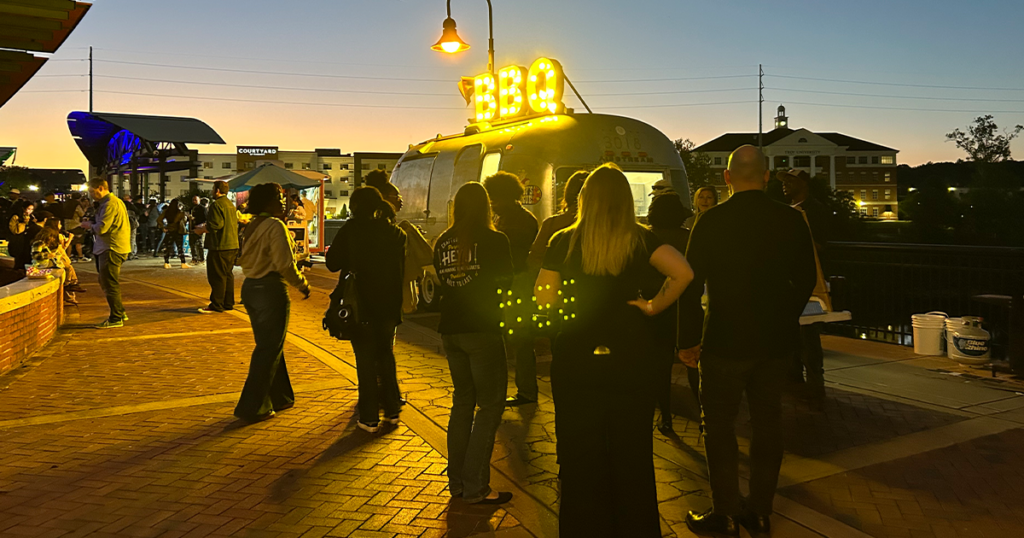

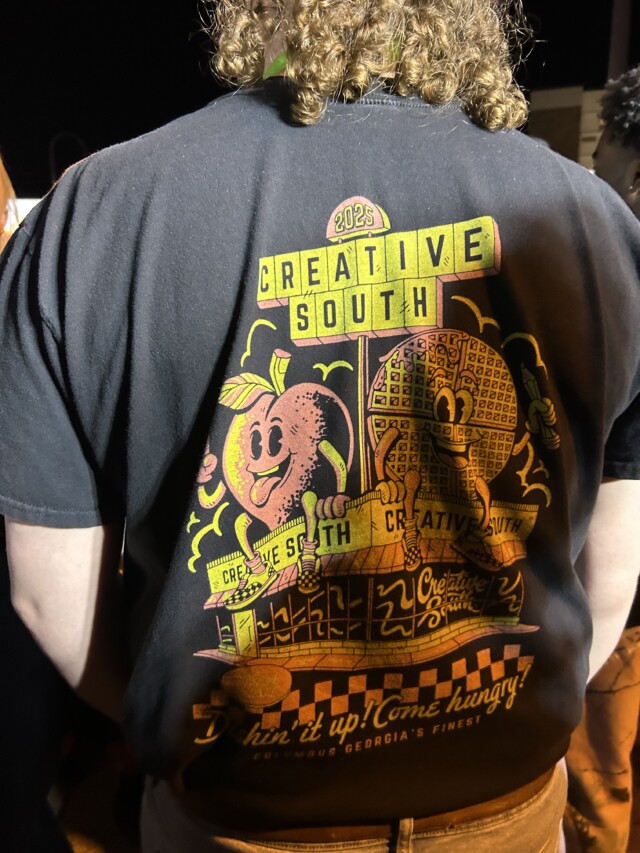
 This April, I took a weekend trip to Columbus Georgia to attend the annual Creative South conference. A frequent question I was asked was, “Is this your first year here?” I learned that many people come back to Creative South year after year. The event is focused on design, but is a multidisciplinary assembly. When I arrived Thursday afternoon, student portfolio reviews were wrapping up. The evening then kicked off with a party on a walking bridge overlooking the Chattahoochee River. Food trucks were set up to rep several local eateries—a highlight for me was a donut and lemonade truck serving fresh lemonade from whole crushed lemons—but the centerpiece of the party was a stage with five large blank canvases. Midway through the event, “Ink Wars” began with several artists racing to create large, playful illustrations under a one-hour time limit while a live audience watched (and danced).
A theme many of the talks centered on was being confident as a designer—whether that meant dealing with imposter syndrome, career setbacks, finding your personal brand, learning to ask for what you want, to seek out mentors, and to be generous to others as a mentor. These personal themes harmonized with the laid-back social nature of the conference. People actually talked to each other, introducing themselves to strangers over breakfast at the hotels or lunch at cafes. The speakers were each approachable for personal conversations outside of their presentations.
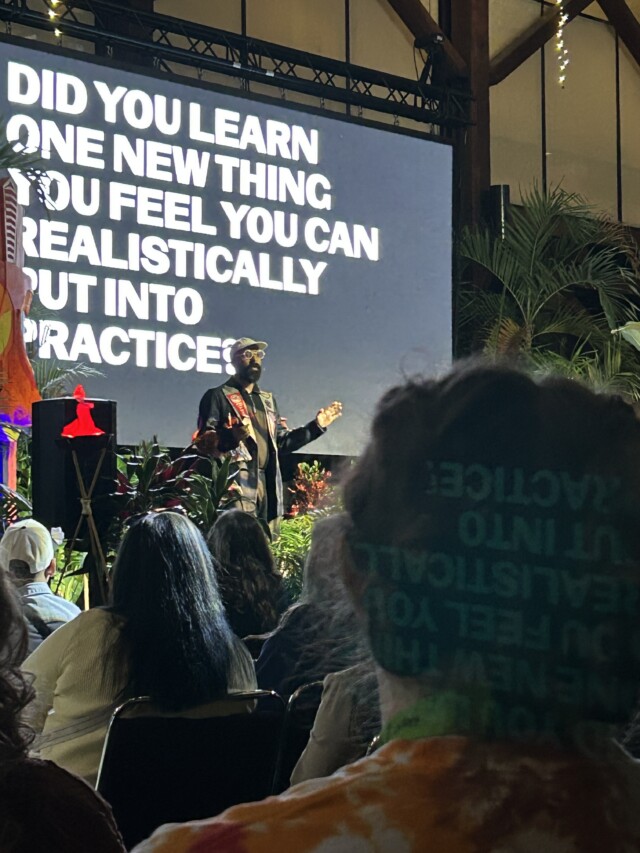
Ritesh Gupta, founder of Useful School, shared a sampling of tips on developing non-technical skills. One takeaway that I liked was different styles of working throughout the day, each characterized by animals. For example, many job schedules assume we are horses, working at a steady, even pace over the course of the day. But maybe you are a lark or an owl monkey (an early riser or a late day or late night worker) or a dolphin: someone who gets bursts of energy and inspiration throughout the day with breaks in between. He also gave some tips on negotiating the value of your work with clients, using screenshots of a real email exchange as an example. This was one of many moments of the conference that touched on the theme of having the confidence to ask for what you want.
Ethan Manning spoke about a strong connection to a sense of place. As a designer from Mississippi, he shared his experiences about sometimes feeling self conscious of negative stereotypes about his home state, despite the fact that Mississippi is a place where so many important cultural figures hail from. Ethan is a Creative Director at Rare Design, a Hattiesburg-based agency that is especially known for its work with sports team branding. Included in his talk was a case study about Rare’s work for the Doosan Bears, a KBO Baseball League team in Seoul. In an engaging story of mutual cultural admiration, Ethan shared how humbled he was that the team reached out to Rare seeking authentic American style baseball branding and about his design team’s trip to Seoul to research the culture around the Korean baseball league. I felt that he used his past experiences with others’ (inaccurate) perceptions about him based on his origin to cultivate the sensitivity needed to collaborate on design with people of different cultural backgrounds.
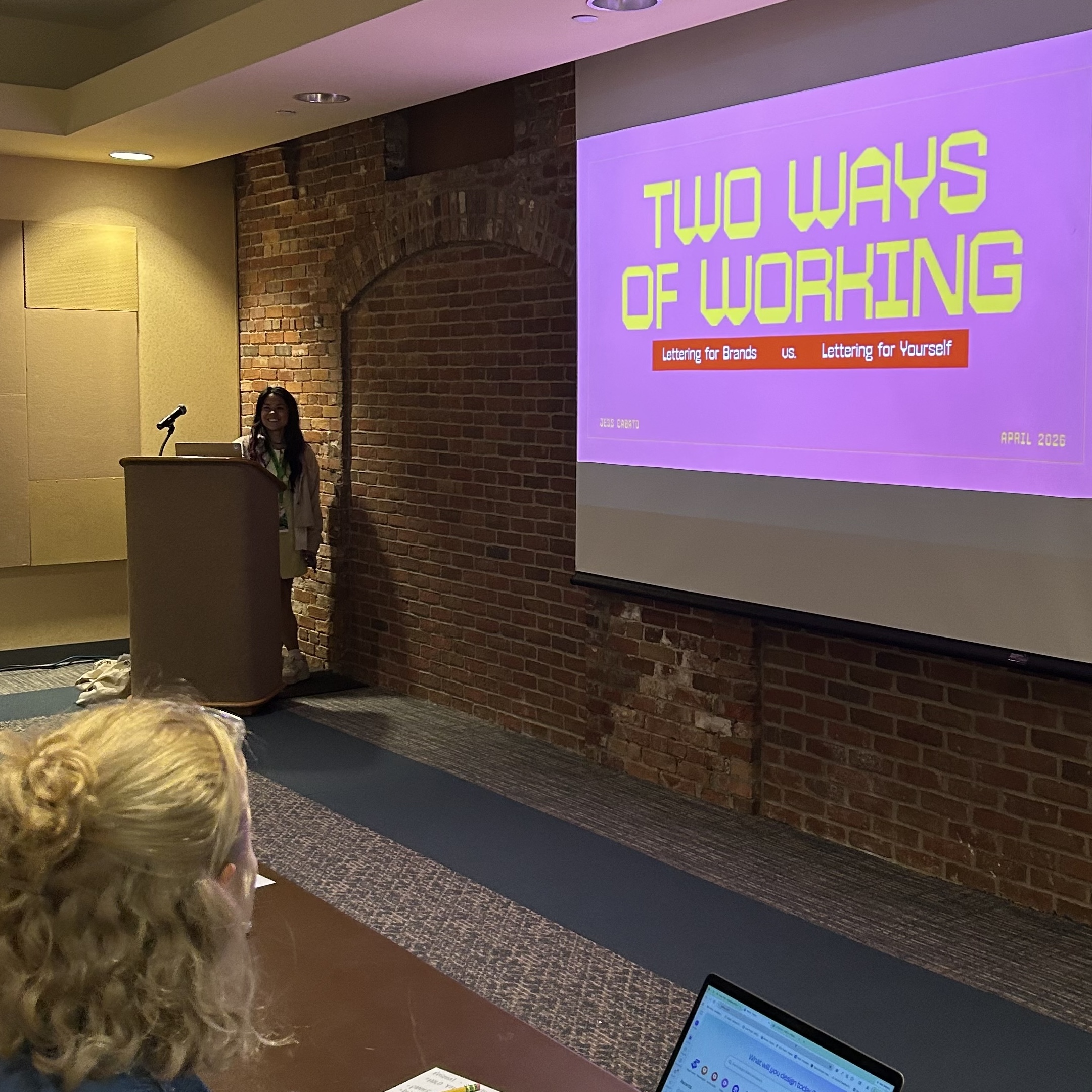
Jess Cabato presented both a talk and typography workshop that I attended. She shared her work as an Art Director at Paramount, in which she manages creative for brand collaborations. Jess showed us the process of creating custom typography for a YouTube series with Ru Paul’s Drag Race and göt2b (example here at 36 seconds). If you know my personal work, you know I’m obsessed with the larger stories behind small details so I was on the edge of my seat as she talked about the journey behind developing the branding and typography for motion graphics that appear for just a few seconds in YouTube videos. She talked about the challenges of the process such as changing the brief midway from a lux print magazine aesthetic to game show style, and working with different brand stakeholders and legal teams. In the workshop Jess gave us two imaginary briefs of crossovers of real brands, and had us draft a typography concept of a catch phrase within the constraints of brand guidelines. That exercise became a warm-up for a personal exploration using the same catch phrase with whatever stylistic concept we wanted. Turns out it can be harder to design without constraints and providing some kind of guidelines for yourself is a good way to avoid decision paralysis. In her talk she shared her personal work in lettering, illustration and murals and how her experience working with corporate brands influences her process in these projects.
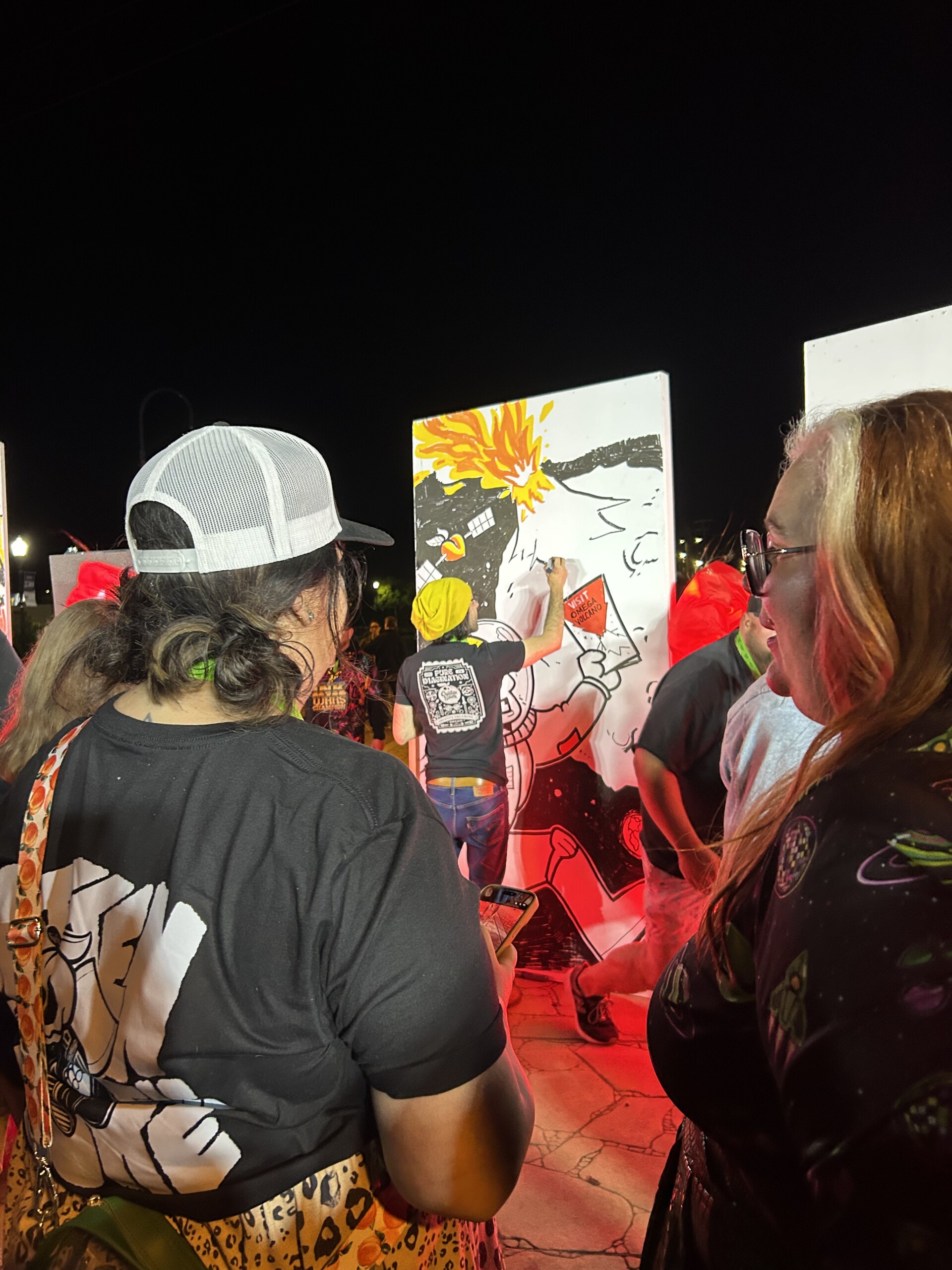
Alejo Porras (in addition to participating in the Ink Wars and presenting a talk) was the ‘visual note taker’ of the conference. For every talk presented (except for his own, haha) he drew a poster-size comic live with illustrations and highlights from the presentation. Visual notes, which can be printed as posters or books, are a way for conferences to include a piece of engaging, lasting ephemera that captures educational takeaways from the conference. One of the parts of his talk that I liked was the story of a mentor at home in Costa Rica who encouraged him while he was working towards the goal of traveling to study art. In a conversation before Alejo left town to begin his studies, the mentor encouraged him to be on the lookout for ways that he could be an influence on other people’s paths—an important lesson.
Creative South draws people together who represent a variety of experience levels and stages in their career. Perhaps 15% (my very not-mathematical guess from a show of raised hands) of attendees were students. The rest of the attendees ranged from designers and marketers in business for themselves, people starting new career paths, and senior employees at agencies. The vendor hall also included a few young illustrators and designers who were in grade school presenting their sticker and t-shirt designs!
Planning on attending a future Creative South Conference yourself? I hope you also have a great first year!
One choice that the conference planners made gave me pause, and while planning my trip, I almost passed up Creative South as an option because of it. Each year’s conference has a theme (last year’s theme was apparently Waffle House, which sounds like it was absolutely amazing). This year’s theme was Inspiration Island, which on its own I think has a lot of potential but the branding, design, and party themes relied on a ‘tiki aesthetic’ which is attached to stereotypes, appropriation, and a history of colonialism. I think as designers we can do better to subvert institutions of imperialism instead of copying them. I’m glad though that I gave the conference the benefit of the doubt so that I was able to meet good people and see great ideas presented.