
Here’s a confession: A part of me walked into HubSpot’s Unbound Conference expecting to be sold to. Three days of talks centered around AI meant I figured I’d hear the same pitch on repeat: work faster, do more, let [insert AI tool here] handle it. As someone who spends most of my days thinking about client relationships, revenue, and how our team can do its best work, I was braced for a lot of “10x your output” and not much about the people doing the outputting.
There were a lot of AI talks. But the message I kept hearing surprised me. I wasn’t hearing “let AI do your job.” What I heard was much closer to “AI changed what your job is, and you’d better get sharper because of it.” I left thinking less about tools and more about how we work, how we lead, and what we are to each other while the marketing industry rapidly shifts right before our eyes.
The 80/20 Flip Nobody Warned Us About
The line that has stayed with me the most came from a session I didn’t initially plan on attending but am so grateful I was in the right place at the right time. The session was titled “You’re Doing AI Wrong, and So Were We.” The speaker described how our work used to be roughly 20% thinking and 80% execution. AI has flipped that. The execution part is faster than ever, so users are now left with more time to think, decide, evaluate, choose, edit, judge, etc.
That sounds great on paper. More strategy, less busy work. But the speaker was honest about the catch: this new system is exhausting employees. Most of us have built our work habits on the old ratio and plenty of people aren’t ready for a workday that is filled with high-stakes decisions. We’re burning out and employers don’t always understand it because it’s less grunt work, but we are more fatigued.
A few key points that I can’t get out of my mind:
- AI isn’t reducing work hours. It’s just intensifying the work.
- Burnout hits your high-performing early adopters first, the people most excited about the tools!
- There is a real addiction to the endless cycle of creation.
- Leaders need to be throughout about what they expect from the time AI “gives back” to their teams.
That last point has especially stuck with me. If employers are operating on the assumption that AI saves someone X amount of time a week, they expect the remaining hours to be filled with more output. However, the better strategy that a lot of organizations aren’t focusing on is allowing team members to pour that time back into craft. Rather than simply increasing their output, allow your employees to grow skills, spend more time engaging in critical thinking, build relationships, and tackle other tasks that improve the quality of their work, not just the quantity. Protecting work-life balance is even more critical now than ever before.
AI Should Make Us Smarter, Not Do Our Jobs
 The 80/20 split was the catalyst for the rest of the conference, where the common theme was how to use AI to sharpen your thinking, not replace it. Put even more simply, you cannot review what you cannot do. As we shift from being writers to being editors, we still need our human expertise and taste to spot what’s not adding up. If we let those critical skills atrophy, we lose the ability to catch mistakes, and we end up in a cognitive surrender, where we accept what AI gives us as the answer rather than a starting point.
I also attended a session on AI hallucinations that made that danger even clearer. The speaker emphasized that plausibility doesn’t mean true. Even if something sounds right and the context matches, it can still be made up. In fact, the speaker shared that court cases involving AI hallucinations went from 16 in 2024 to 827 in 2025, and in just the first half of 2026 alone, there have already been 831. Trust isn’t a property of the model, it’s a crucial component of the entire system.
Below are some guardrails that the speaker emphasized:
- Match the loop to the risk: High-risk work needs a human involved in the approval process before anything goes out. Lower risk work can have a human monitor rather than sign off.
- Make “I don’t know” a valid answer. Tell whatever tool you are using that “not found” is an acceptable result. And always remember to ask for sources, dates, and URLs so you can check its work.
- Evaluation is the new core skill. The most valuable team members moving forward will be the ones who can juggle, evaluate, and improve AI output.
- Taste cannot be outsourced. It’s imperative to remember that taste is human and an AI tool cannot provide that. Users should spend time building “taste profiles” that teach the AI tool how your brand talks, what stories you tell on purpose, and what you’d never say. You need to describe your taste to AI, not let it define a new one for you.
Beyond the tips on how to best use AI, a lot of speakers also talked about how it’s changing marketing and how this is the slowest evolution of change we will all live in again (scary I know, since it feels fast already). But as a speaker pointed out, AI ships you and your competitors the same thing at the same time. What can’t be copied, however, is taste and experience. AI may buy you speed, but it’s your experience that will buy you memory.
Clients don’t stay with an agency because it’s fast. They stay because they trust the people. If AI frees us from execution, the win isn’t more deliverables sent to clients. The win is providing the account team with increased capacity for judgment, relationships, and human attention.
A Quick Detour into the Numbers That Stuck With Me
A few stats that I wrote down throughout the conference that underlines what I’ve been discussing:
- 78% of organizations globally have adopted generative AI in at least one business function.
- 95% of generative AI pilots deliver zero measurable results, and 42% of S&P companies scrapped most of their AI initiatives last year, up from 17% the year before.
- 86% of buyers would pay more for a great experience, and a third will abandon a brand they love after one bad one.
- Brands that pumped out more creative variations saw about 65% more return on ad spend with the same budget. Volume matters, but only when quality holds up.
- AI-referred traffic converts over four times better than the average site visit. Fewer people click, but the ones who do are ready.
Leaders Bring the Weather
And then there was Mel Robbins. I expected her to talk on the 5 Second Rule and to be a nice motivational break. It ended up being the session I’ve quoted the most to people who ask about my conference.
Her core message was for those in leadership positions: you bring the weather. Your energy walks into the room before you do. If you are chaotic, your team feels it. If your team is afraid to make mistakes around you, they won’t trust you. She challenged us all to check ourselves before starting work and before going home, and to take responsibility for the climate we create.
 She then built on that with a few ideas I’ve already tried implementing in my day to day, both at work and at home.
- People do well when they can. As someone in a leadership role, it’s important to create conditions where people can succeed, and that success starts with a clear definition. If people don’t know how success is measured, they’ll exist in a state of constant anxiety.
- If you have to micromanage, your team doesn’t know what’s important. And if everything is important, nothing is.
- Let them and then let me. If you aren’t aware of Mel’s let them theory, it’s essentially reminding yourself that you cannot control the behavior of others, but you can control your response. Power lives in that response, and in not trying to control others.
- When you’re stuck, make a move. When you know what to do but can’t make yourself do it, count down from 5 and go! That way you are acting before anxiety has the chance to catch up.
This is when everything clicked for me. If the 80/20 flip means our teams now spend most of their day doing hard thinking work, the weather leaders bring matters more than it ever has. An anxious, unclear, always-on environment makes that cognitive load heavier. A calm environment with clear definitions of success makes it lighter. AI can speed up execution, but it can’t set the company culture. That part is still on us.
What I’m Taking Home
If I had to sum up Unbound in one sentence, it would be:
AI isn’t supposed to make our jobs easier, it’s supposed to make them better. And that can only happen if people stay sharp and leaders create conditions where employees can thrive.
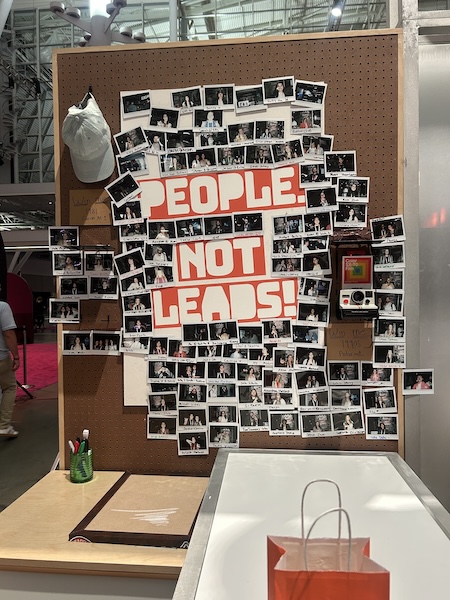
For me, that means a few things going forward: being more intentional about what our team does with the time AI saves them day to day, keeping human judgment front and center in client work, and checking my own weather before I walk into a meeting. It also connects right back to one of our core values: Keep it Human. We do business with people, not products, and that’s never hit home for me more.
Wicked Good: A Quick Boston Review
If you’ve made it this far but are wondering what I thought about my time in Boston, have no fear! My brief review is here:
- More cobblestones than my feet were ready for.
- A Maine style lobster roll is superior to a Connecticut style roll.
- I cannot live in a city with a cannoli spot on every corner, I have zero restraint.
- Don’t say you don’t like Matt Damon or Goodwill Hunting in public, you will get dirty looks.
P.S. Thank you HubSpot for everything, but a special shout out to you for hiring Kyle Cooke to DJ, that was 10/10.