
Being a designer these days can be a little tough. News of layoffs, endless AI talk, and ever-greater focus on faster and cheaper output over craft and consideration has had me feeling like creative work is being devalued all over the place. When I got to Config 2026, I was feeling disillusioned about my industry and honestly not that psyched about the conference. There were a TON of AI-related talks on the docket. I had convinced myself the conference would be full of tech bros, and I was just going to have to power through it. A great mindset!
There was a lot of AI content, and I did meet a nonzero number of tech bros. But Config surprised me! I left the conference feeling intellectually energized and less alone in my AI doom brooding. Read on for the things that surprised me at Config 2026.
A note: I did not attend every talk and I have yet to watch every recording! This is just based on my Config experience.
AI, of Course, but Bear with Me
A design conference in 2026 is obviously going to have AI content, and there’s obviously going to be a range of opinions on it. No surprises there. But there were several things that did surprise me about the AI content I heard at Config, in a range of ways.
Figma’s CEO, Dylan Field, started the conference by saying he thinks AI has lowered the floor but not raised the ceiling of creative work. He then said he thinks creatives’ effective use of AI is our chance to raise the ceiling. I was happy to get this bit of nuance from the beginning, from the top: framing AI as a tool to be used by us as creatives, not to replace us; a tool whose output depends on the intention and skill of the person using it. Even if it was a bit of pandering from a speaker who knows his audience, it felt mildly reassuring.
I attended a talk where the speaker showed us his team’s workflow for creating fully AI-generated product mockups. It was a smooth setup, and the exports looked good. He didn’t mention anything about disclosing that the mockups were completely generated by AI, though, which was wild to me for an e-commerce product. It’s totally possible they do this, and it just wasn’t mentioned in the talk. But when there’s already no way to physically see a product before I buy it, and I’m not even getting a real photo of it, as a consumer I’d at least like an acknowledgement of where the product imagery came from. The surprise here came from the dissonance of priorities: meticulous about craft but unclear about attribution.
In a panel discussion, speaker Rasmus Andersson said that having higher production capacity with AI means we should create a higher quality, not higher quantity, of work. Say it louder for the clients in the back!
One of the Figma team-led presentations included AI-generated imagery to visualize a pretty simple metaphor they used when explaining one of their new features. The visualization felt unnecessary, like they were spoon-feeding me the analogy. Another Figma team member in that presentation referred to “the magic of AI,” which also felt like it muddled the CEO’s initial message a bit. (In another talk, speaker Rose McManus used screenshots of Google Images search results to show photos that would have otherwise been difficult or expensive to get legitimate usage rights to, like images of famous people. Way cooler than a generated image.)
I really enjoyed the final keynote, given by André Anjos. It’s worth watching in full! He said several things that I was surprised and happy to hear at a conference for a product with a million new AI features:
- He called generative AI a “consensus engine” that makes average work. Audiences will never love average work the way they love good work.
- As a creative, you’ll always feel a pull towards creative safety, the easy road, or what’s worked before. This was the case before AI, and now with AI, it’s easier than ever to give in to that pull. That pull, he said, wins against you by making things good enough for you to settle for.
- Not risking anything and avoiding any potential for failure is characteristic of a machine, not a human. “Don’t let it think for you.”
A Detour into the Unsurprising but Still Interesting
I met a lot of people at this humongous conference, and almost every conversation I had turned to AI at some point. It was really interesting to hear the range of people’s experiences around AI. A few things that stuck with me from the conversations I had:
- One person told me they feel “gaslit” about the impact of AI. They said their bosses are really hyping up how much time they expect everyone to save without being straightforward about where that time should go instead, and it feels like there’s an unspoken possibility of layoffs.
- I was speaking with another person about how excited I was to test out some of Figma’s new AI-powered features, and they kept things in perspective for me by reminding me that Figma had not disclosed how many tokens any of the new agentic features would use once they’re out of beta. They expressed feeling very suspicious that teams would become reliant on these agentic tools while incurring no extra costs, then be forced to pay potentially exorbitant extra fees on top of subscriptions when the time comes. Will these features become only available to those who can afford to use them?
- Another person who manages a creative team said they feel like they have to walk a line between their company’s leadership, who are all in on AI and think it’ll “10x” company productivity, and their team, who are less convinced. They seemed to be struggling with being accountable to their team, almost in opposition to maintaining their own job security and their bosses’ trust in them.
I really appreciated all of these conversations and more that I had with the many smart people I met at this conference. I don’t think any of these things are unique, not to these individuals or our industry. From my observations at Config, the AI dread that I’ve experienced and many other designers I met were feeling seems to correlate with having less power, or at least feeling less powerful. The people I heard from on stage or in conversation who are business owners or otherwise successful and established seem a lot more positive about the influence of AI. The people I talked to who are just regular creatives, who are maybe early in their careers, work for themselves, or just aren’t in powerful or tenured positions, are worried about it. I wrote in my notes about AI, “yet another tool that’s benefitting people who are already ahead.” But that’s enough with the unsurprising stuff!
Music as a Parallel Medium
Another surprising aspect of Config was the integration of music throughout the conference, starting with the cool background and interstitial music that played between talks and as the soundtrack to the awesome keynote opener, then morphing into a meaningful area of focus. We even got a live coding musical performance on Thursday morning, a new experience for me that got me into a really funky (complimentary) mood.
A few of my favorite talks had to do with music. André Anjos, discussed above, is a musician. From the audience, I felt a lot of camaraderie with him, hearing that the music industry and musicians seem to be experiencing a lot of the same feelings we are in design.
Brent David Freaney, who designed the album cover for Charli XCX’s brat, spoke about how he’s leveraged design as a means of being in spaces with the people he wants to associate with, like musicians. (He also had an impressive lean towards transparency in his talk, more below.) I loved Brent David’s comparison of how fans engage with music to how audiences engage with design. With this mindset, the audience, rather than the work, serves as the medium, and the audience’s interaction with the work is the final, ongoing step in the design process. If people ever take something I design and run with it as far as they did with the brat album design, I’ll retire! For now, though, it made me think a lot about how to conceive of the success of a design, and gave me another lens for not letting perfect be the enemy of good.
I also really enjoyed a talk from Lauren Loprete, who used punk music and the larger punk ethos as a framework for talking about brand system design. She compared successful brand systems to good punk music venues she’s frequented in her life, which set ground rules in order to provide an environment for people to work and make art in. Control, she said, is at odds with innovation, and like a music venue, a brand system should step back and let the music play. And she put on “Heart of Glass,” which is a perfect song. This talk also helped me think about what makes branding work successful—not playing a cop with a bunch of rules, but creating a coherent structure and trusting that it will set the stage for even better work to come.

I love music, and it was a nice surprise that it kept coming up. Having the parallel of music also helped me think about some of the AI messiness in a way that felt slightly less personal, but that I still felt close enough to process and relate to, both as a creative and as a music fan. As a fan, I don’t want to listen to music that only sounds like things I’ve already heard. An audience for design work is the same—even if they’re not fans in the same way, audiences are not going to get excited about boring, average design, and they certainly won’t accept junk. And trust issues aside, audiences especially won’t accept boring work from sources that used to give them good stuff, when other sources are still giving them good stuff. This affirmation gave me hope. Completely turning creative work over to AI will never “10x profits” if audiences are bored and stop listening (or buying).
Brilliant Levels of Transparency
The final category of my Config surprises is transparency. While not necessarily a theme throughout the conference, there were a few instances that really stood out to me as notably transparent choices.
I mentioned above that Brent David Freaney’s talk was super transparent. Not only did he show us a video of himself at age 14 in which he screams and cries (in excitement), he also opened up the Figma file he used when developing the brat album cover as part of a discussion of his process. Just opened it up and scrolled around in there in front of thousands of us! We got to see the cluttered frames, the pieces of inspiration scattered around the canvas, things that all of us have in our working files but usually keep hidden. Brent David even walked us through how he got the grainy effect on the album cover, showing us his charmingly low-fi process in real time.
Another brief instance that sort of shocked me in its level of transparency came during Matt Roger and Elliott Muñoz’s talk about a project they worked on together for ESPN. This was a very ambitious project, huge in scale, and it sounded like they had to move pretty quickly, too. They did finish the project—but, they acknowledged during their talk, they did not actually meet all their goals. One goal in particular, for making a universal type ramp system, had to be sacrificed in order to complete the project on time. To hear something like this from people who work at a fancy agency and a gigantic company was really refreshing, and again, made me feel a real sense of camaraderie with the design community. Even ESPN sometimes has to shift their goals and acknowledge their shortcomings!
One more cool transparency moment came in the talk immediately following, when Ben Shown and Megan Greco discussed their process for building NASA’s new website. An early deliverable their team gave to the federal agency NASA to help visualize a potential navigation design approach was a sketch of a Murphy bed. Just a sketch! And when they were discussing site users, rather than making traditional user personas, they used Muppets characters as representatives of NASA’s audiences’ thinking styles. I was delighted to see they had used such playful approaches to designing for a government institution, and I’ve been looking for ways to take that mindset back to my own projects.
Two More Things that Inspired Me…
…but didn’t fit into my categories:
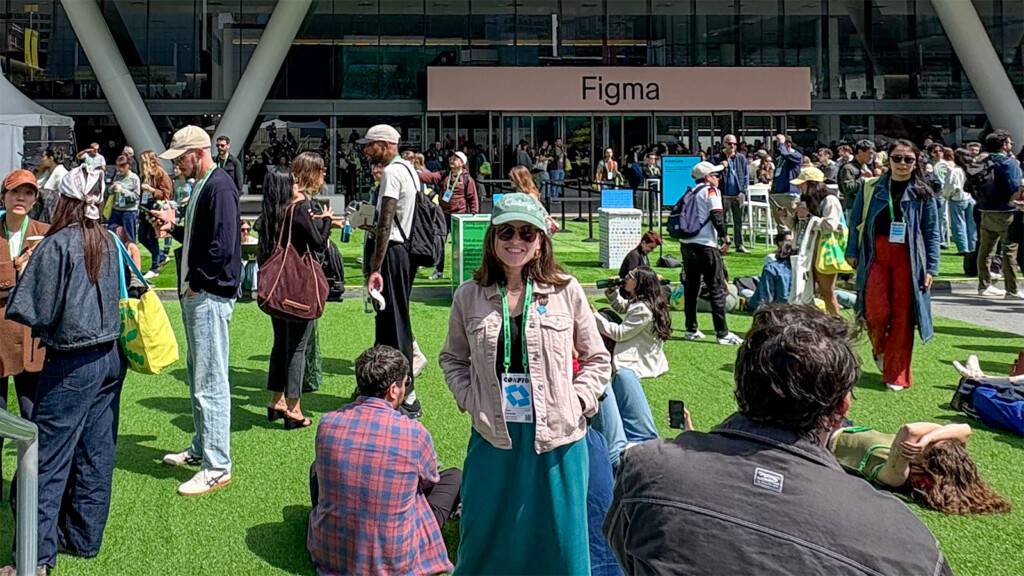
- After sitting in dark rooms all Wednesday morning, I sat on some turf in the sun to listen to a talk on the outdoor stage. While speaking on learning from your brand’s community, Alicia Kranjc encouraged us to try things that don’t scale, and to fight the instinct to systematize everything. Sometimes you can invest in a fun thing just once, and it’s still worth it. This felt very grounded and human amidst all the AI talk! And it was the closest I came to touching grass in San Francisco.
- Two quotes from Jésabel DC’s talk on incorporating practices from early 2000s interface design stuck with me. One, “don’t ask people to do the work themselves that the design should’ve done.” Two, “design with a secure attachment style,” with the idea being that you should make something good so that people come back (a reciprocal model), rather than making something that traps people so they can’t leave (an extractive model). Think Animal Crossing vs. TikTok. This was almost more personally inspiring to me than professionally—why would I use something that traps me?
All in all, I’m so glad I got to attend Config! It was also my first time in San Francisco. As a signoff, here’s my travel review: way too many AI billboards, freezing cold in June, and lots of really delicious food!