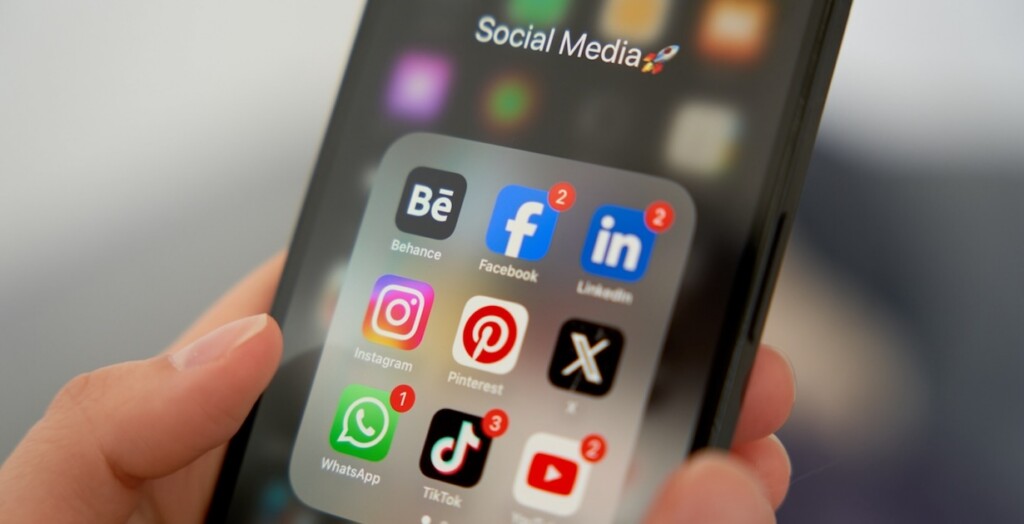

Scroll through any feed right now and you’ll run into a caption that reads a little too polished, a graphic that’s almost perfect but slightly off, or the now-familiar “AI info” tag tucked under a post.
AI-generated content is everywhere on social media right now, and it isn’t going anywhere. The real question is where it makes your work better, and where it just makes it look cheap.
Here at Online Optimism, we use AI every day, but in the same way we’d use spellcheck. It’s a tool that helps us move faster, never something we let run unsupervised. Every AI-assisted deliverable still gets a real person’s eyes on it before it ever reaches you.
Here’s what that actually looks like day to day.
WHERE AI CAN HELP YOU
Brainstorming and Ideation
The best use of AI in social strategy is asking it to widen the net before you write a single word. Use it to generate volume, a lot of ideas fast, then apply your own judgment to pick the one actually worth developing. AI is great at quantity. You’re still the one who knows which idea will land.
Below are a few starter prompts by use case. Swap these out once you’ve got your own stack you like.
For building out content buckets:
- “Here’s a client/brand I’m working with and a little about them: [brand info]. Their main audience is [audience]. Based on this, can you help me come up with some content pillars or buckets that fit the brand and audience?”
For fleshing out an idea:
- “I have this content idea: [idea]. Can you give me ways this works for the brand and ways it doesn’t, or ways it could fall flat?”
For insights or feedback:
- “Here are some highlights from a report, plus the full report. Can you look into this and help explain why there was an increase or decrease in [metric]?”
None of these outputs go straight into a content calendar, by the way. They’re just a starting point. The real thinking still happens with you, which is the part a client is actually paying an agency for.
Research and Quickly Scanning Documents
This one’s probably the most underused way to bring AI into the process. Tools like Claude’s Chrome extension (or similar AI browsing tools) let you troubleshoot a landing page or pixel setup in real time, or compare two documents side by side, like a proposal against a contract or an old brief against a new one, instead of digging through everything by hand or copy-pasting into a chat window. It’s also handy for pulling the key points out of something long, like a research report or a client’s brand guidelines, so you know what matters before committing to reading the whole thing.
Just don’t take the output as gospel. You’ll still need to go over it yourself, but it’s a great starting point and it saves time.
Planning and Project Management
This might be where AI adds the most value for the least risk. AI is good at:
- Turning a rough list of content ideas into a structured calendar with a logical cadence
- Flagging gaps in a content plan (say, five posts about the same product feature and nothing about pricing)
- Mapping out a production timeline with due dates for copy, design, approvals, and posting, working backward from a launch date
That’s the kind of process work AI is great at, doing the timeline math so a human can focus on the planning decisions. None of this touches what your audience actually sees. It just makes the process of getting there way less chaotic. If you’re the one keeping fifteen client calendars straight in your head, this is worth testing.
WHERE AI SHOULD STAY OUT
Here’s where we draw a hard line, and it’s the same line most audiences are already drawing themselves.
Don’t copy-paste AI-generated copy or captions. Not because it’s against any rule, but because people can tell, and they’re getting increasingly annoyed by it. LinkedIn is a great case study here. After reports found a large share of longform posts on the platform were AI-generated, LinkedIn built an actual “seems like AI slop” button, and more than a million people used it within the first few weeks. LinkedIn also killed its own “enhance your post” AI writing feature in favor of a proofreading tool that doesn’t rewrite anyone’s voice. When the platform itself is building tools to help users detect and downrank AI writing, that’s not a trend worth riding.
Don’t autogenerate final graphics. A generic AI-generated image reads as generic, and increasingly it reads as suspicious. Research from The Harris Poll, 4As, and Infillion found that 78% of consumers think AI makes ads feel less authentic, and 73% said they’d be less likely to trust an ad they suspected was AI-made. That distrust isn’t limited to paid social media either. This year’s viral backlash over AI-generated food photos on restaurant menus is a good example of how badly this can land. Diners said an obviously AI-generated image instantly makes them trust a business less, regardless of how the actual food looks.
Watch for AI text watermarking, too. This one’s newer and worth flagging to your team. As of August 2026, Anthropic began embedding watermarks into AI-generated text from Claude, along with other major AI providers under the EU AI Act. It’s invisible to readers, but it means AI-written copy now carries a detectable signature that doesn’t just go away with light edits. A heavy edit or full rewrite can remove it, but the takeaway stands. The more a caption is generated rather than human-written, the more likely it is to get flagged down the line, on whatever platform it ends up on.
WHAT COUNTS AS AI IS TRICKIER THAN YOU THINK
Instagram’s Adam Mosseri has said outright that Instagram won’t filter AI-generated content out of your feed. It’ll get labeled, and users can decide for themselves whether to keep scrolling. Meta spent the back half of 2026 rolling out automatic AI detection across ads, so this isn’t theoretical anymore. It’s baked into the ecosystem, and it’s more complicated than it looks.
Meta’s AI detection isn’t just checking whether someone typed a prompt into an image generator. It reads embedded metadata (called C2PA Content Credentials) that gets baked into files by all kinds of everyday editing tools, not just generative ones. Canva, Photoshop, Lightroom, CapCut. Any tool built on the C2PA standard can attach that metadata the moment you save a file, whether what you did was generate an image from scratch or just remove a background, retouch a blemish, or run a basic color correction.
That means a designer can round-trip one asset through two or three different tools during a totally normal edit (crop in one, color-correct in another, export from a third) and end up with a file tagged “AI info” even though nothing in that chain was actually generative. Background removal is a great example. Most people would call that completely ethical, non-AI photo editing, but depending on the tool, it can still leave AI-adjacent metadata behind.
But here’s the thing: even Meta doesn’t have a firm grasp on this yet. Meta has acknowledged its detection isn’t perfect, and there have been cases of completely non-AI, legitimately shot and edited photos getting labeled “AI info” simply because of leftover metadata from an earlier edit in a different tool. This isn’t a “just follow the rules and you’re fine” situation since the system is still catching human-made content in its net. The burden is on you to know your tools rather than trust the label to always get it right.
That said, if you use AI the way we outlined above, for brainstorming, research, and planning, and a human writes the caption and designs the graphic, none of that triggers a label. The label only fires when AI touches the output your audience sees, and minor edits like cropping or basic color correction don’t trigger it either.
THE BOTTOM LINE
AI is a tool that should make your team smarter and faster. It’s not a shortcut that replaces the judgment your audience actually showed up for.
Use it where it saves you time and sharpens your thinking, and keeps humans on the parts your audience actually reads, watches, and judges you by. Do that, and you won’t have to think twice about whether your audience trusts what they’re looking at, because you already built it the right way.