
I always come home from a conference with a full notebook and a running list of things I want to try. This year at SMX Advanced, that list was longer than usual—and nearly all of it circled back to one theme. AI isn’t a session topic anymore. It’s the lens for almost every conversation we’re having about search.
If it feels like the ground is shifting under our industry, you’re not imagining it. But after three days of keynotes, sessions, roundtable discussions, and conversations at networking events, I left more energized than anxious. The fundamentals we’ve always cared about still matter. They’ve just gained some new company. Here are the takeaways I keep coming back to.
Good SEO Is Still the Foundation—It’s Just Not the Whole Building
The most reassuring throughline of the whole event was this: good SEO is good GEO. AI search still relies on grounding—pulling in current, factual information—when it answers a question, and most AI search failures are really retrieval failures. If your content isn’t crawled, indexed, and structured clearly, you can’t be retrieved, which means you can’t be cited. Technical SEO, clean site architecture, topical depth, and internal linking are all back in the spotlight.
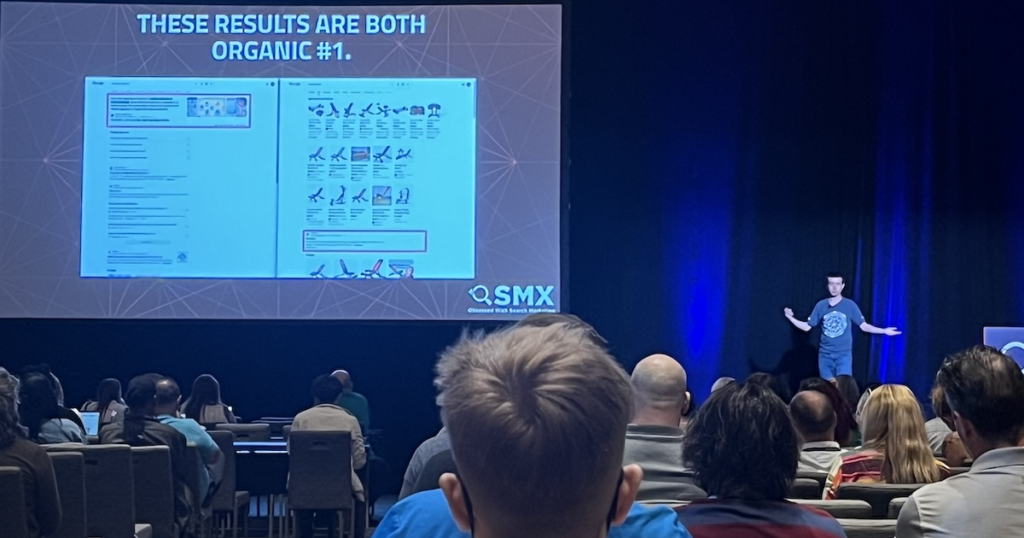
What’s changed is that ranking is no longer the finish line. One speaker mapped out how the search funnel has grown a new stage. Traditional SEO went: crawl, rank, click. AI search goes: crawl and index, rank, retrieve, synthesize, cite or mention, and then maybe click. A page can rank #1 and never show up in an AI answer, while a page sitting at #8 gets cited over and over. Citations are selected during retrieval, not ranking—so position alone is no longer a reliable proxy for whether AI can actually see you.
My top takeaway: keep doing the fundamentals well, because they’re your foundation. Just don’t assume that ranking well is the same thing as being visible anymore.
Brand Mentions Are the New Currency
If I had to name the single most repeated idea across the conference, it would be this: AI rewards brands people talk about. LLMs are probabilistic systems trained on patterns of trust and repetition, and as one presenter put it, if nobody talks about your brand, AI has very little reason to either.
That means the work is shifting off-site. Most AI citations come from third parties, and mentions—linked or not—reinforce your brand as a recognized entity. Reviews, community discussions, PR coverage, and unlinked brand references all count, and third-party validation counts more than anything you publish about yourself. With GEO, you often just need the mention; you don’t even need the backlink.
A few major strategies I noted:
- Become a source journalists trust. Run your own surveys for exclusive data, mine free government datasets like the Census and BLS, and use search trend data to spot questions journalists aren’t answering yet—then pair the data with an expert quote.
- Lean into YouTube. Branded mentions on YouTube, and mentions in popular videos, showed up again and again as some of the strongest signals for AI visibility. Structured, conversational video transcripts are easy for models to extract and corroborate.
- Get into the communities where your audience already is. Reddit came up constantly. For local businesses especially, being genuinely helpful in a niche subreddit before you ever pitch yourself is a real strategy.
Fundamentals like brand, PR, and link building never actually went away—AI is simply restating their importance in new ways.
Write Content That’s Modular, Answer-First, and Actually Original
Two ideas kept bumping into each other in the content sessions, and I think the tension between them is important to recognize.
The first is structure. AI systems retrieve chunks, not pages. A 4,000-word guide organized around your preferred outline, with the answers buried mid-paragraph, forces the retrieval system to guess which passage answers which sub-intent. The same content restructured to be modular—clear definitions, answer-first sections, comparison tables, FAQs, structured data—is far easier to grab. “Lost in the middle” is a real positional bias in how these systems read, so get to the point quickly.
The second is distinctiveness, and this is the one I feel most strongly about. There’s enormous pressure right now to produce faster with AI, but we’re buying that production speed at the cost of standing out. One study shared onstage found that only 26% of people say AI makes their work faster and better, while nearly half admit it makes their work faster but more average. If you’re scaling average, you’re not adding value—you’re adding to the pile. And trust is on the line: a meaningful share of consumers say their trust in a favorite brand would drop if it used AI for most of its marketing.
My rule of thumb is to use AI for formatting, outline, and tone, but write for humans, by humans. Bring original data, a genuine point of view, and real subject-matter expertise. That’s what earns citations, and it’s what keeps you distinct while everyone else races to the middle.
Your Rendering Strategy Is an SEO Decision Now
This was a session that went straight to my to-do list. Roughly 69% of AI crawlers can’t execute JavaScript. That means a JavaScript-heavy page can rank #1 on Google and be effectively blank to ChatGPT, Claude, and Perplexity, because those crawlers only see the raw HTML your server sends back—not the content that appears after JavaScript runs.
If your content needs JavaScript to appear, AI search mostly doesn’t know it exists. The pages where this hurts most are often exactly the ones you want cited—product pages, comparison and “vs.” pages, pricing pages, and documentation or FAQs.
The good news is you don’t need engineering’s permission to start diagnosing it. Here’s the 5-step, 5-minute audit you can run yourself:
- View the page source.
- Disable JavaScript and reload.
- cURL the URL to see the raw response.
- Search for a unique phrase from your content to confirm it’s actually in the HTML.
- Check your server logs.
If your critical content vanishes when JavaScript is off, you have your answer. And when you take it to your dev team, frame it in their language: server-side rendering is a performance win and an AI win. It’s not “the SEO stuff”—it’s a discoverability problem that better performance also solves.
Measurement Has to Evolve with AI
If there was a hard truth at this conference, it’s that our old scoreboard doesn’t work anymore. Influence increasingly happens without a click—on average, sites see only around 0.5% of their traffic come from AI engines, so referral traffic was never going to be the goal of GEO.
A couple ideas to consider:
- Track presence and prominence separately. Presence is simply whether you show up—a yes or no. Prominence is whether you show up meaningfully: Are you in the top few results? Is the description accurate? Is the framing positive? Visibility can actually hurt you if you’re being represented inaccurately, so it’s worth watching the framing, not just the appearance.
- Lean on AI Visibility %. Rather than obsessing over any single prompt, choose a set of prompts that reflect the full customer journey, track them consistently over time, and calculate how often you’re included. It smooths out the wild run-to-run fluctuations you get from checking a single prompt just once.
Local Search Isn’t Exempt from AI
For anyone doing local work, the shifts are just as significant. Around 46% of Google searches have local intent, and a large share of users now lean on AI Overviews for local answers—which is pulling clicks away from the map pack. The goal is no longer just ranking in the pack; it’s becoming the source AI trusts and cites.
The practical steps haven’t changed as much as you’d think. Proximity is still a major ranking factor, so build out location pages for the surrounding neighborhoods your Google Business Profile can’t reach. Keep your GBP active—posting there is genuinely underutilized. Swap stock photos for real images of your business. Gather reviews. And get active in local communities and forums, where helpful answers often become citations down the line.
GEO Is Changing How We See SEO
For years, SEOs were treated as tactical specialists. But the core skills AI visibility demands—thoughtful content architecture, semantic understanding, a solid technical foundation—are exactly the things our discipline has been prioritizing all along. If anything, this shift puts search professionals at the center of the AI strategy conversation.
None of this is fully settled, and it’s moving fast. GEO is still a new enough channel that the playbook is running ahead of the dashboards, and best practices will keep changing. But the path forward looks a lot like the work we already believe in: build a real brand, publish genuinely useful and original content, make sure machines can actually read it, and measure what matters instead of what’s easy.
That’s the list I came home with. Now to start working through it!